How to Repair Corrupted JPEG, TIFF, PNG and BMP Files
Learn how to repair damaged or corrupted JPEG, TIFF, PNG and BMP images that won’t open, display incorrectly, or were corrupted after data recovery. This guide shows how to analyze damaged files, preview the repair result, and save repaired copies with Hetman File Repair. To get started, download and install the program.
Select Files to Repair
Select the damaged or corrupted files you want to repair. You can add multiple files from different folders, and the wizard will process them automatically and save the repaired copies to the folder you specify.

Step-by-Step Repair Wizard
The step-by-step wizard is the easiest way to repair multiple damaged or corrupted files. It guides you through the entire process, from selecting the files and choosing a repair method to saving the repaired copies.
To launch the “Recovery Wizard”, click its icon on the main toolbar. Instructions for each step are displayed at the top of the wizard window.
You can also configure File Repair™ to open the “Recovery Wizard” automatically every time the program starts by enabling the corresponding option.
Click “Next” to continue.
Select Files to Repair
Add the damaged or corrupted files you want to repair. You can select multiple files from different folders and process them together in a single operation.
For images, switching to “Thumbnail” view can make it easier to identify files with visible corruption, incomplete previews, or other visual defects.
At this step, you can use the following commands:
- “Add files” – add more files to the repair list;
- “Remove files” – remove selected files from the repair list;
- “View” – change how files are displayed. You can choose between icon, list, and table views;
- “Sort” – change the order in which files are displayed.
When all required files have been added, click “Next” to continue.

Repair a Single File Manually
If you want to inspect a file before repairing it, use File Repair™ in Explorer mode instead of the wizard. Explorer mode lets you browse folders, select an individual damaged file, analyze it, and preview the repair result before saving it. When you need to process multiple files, the step-by-step wizard is usually more convenient.

Select a File
Select the folder containing the damaged files. File Repair™ will display the supported files found in that folder, allowing you to select the file you want to analyze and repair. Unsupported file types are not displayed.
Preview the Repair Result
A damaged file may fail to open or display correctly before it is analyzed. Select the file and run the “Analyze” or “Research” command. If the program can reconstruct the damaged file, you can preview the result before saving the repaired copy.
Save the Repaired File
After the file has been analyzed and repaired, File Repair™ opens the saving wizard. You can choose the destination folder, specify how files with duplicate names should be handled, preserve the original folder structure, or save all repaired files to a single folder.
Choose the Best Repair Method for Damaged or Corrupted Files
Choose how the program should analyze and repair the selected files. Use “Analyze” for a faster repair of common structural errors, or “Research” for a deeper analysis of severely damaged files. Start with “Analyze” for typical file corruption. If the result is incomplete, try the more comprehensive “Research” mode.
- “Analyze” – quickly examines the file structure, detects logical and structural errors, and attempts to repair them. This is the fastest method and is recommended as the first option for most damaged files.
- “Research” – performs a deeper content-level analysis of the entire file. It takes longer, but can reconstruct files with more extensive structural damage and extract usable data that is still present when standard analysis is not sufficient.
Neither method can recreate data that has been physically overwritten or is no longer present in the damaged file. However, “Research” may produce a better result when enough intact data remains to reconstruct the file.
Select the appropriate repair method and click “Next” to continue.

Save the Repaired Files to a Safe Location
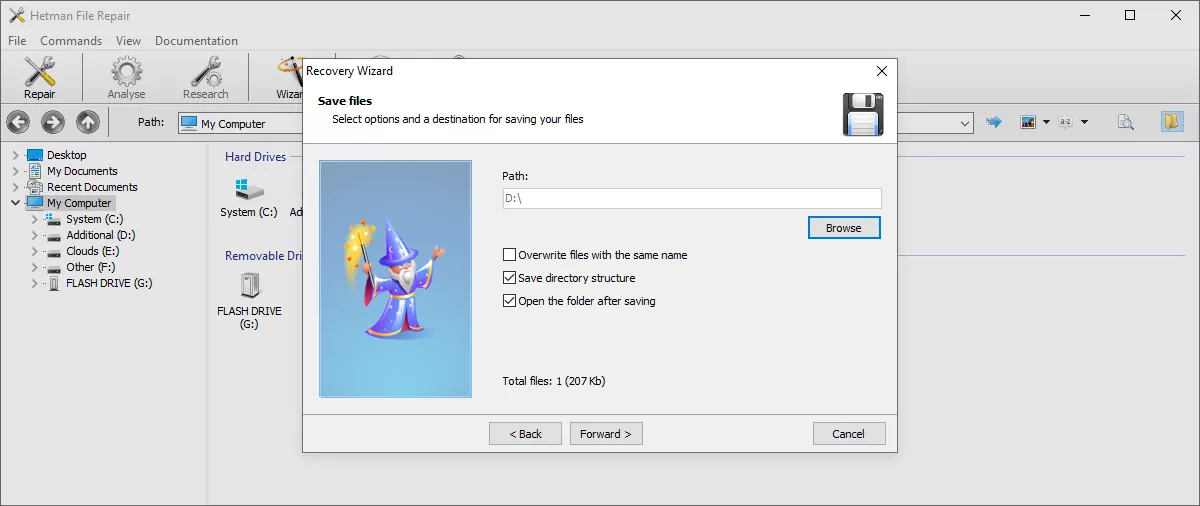
Choose where the program should save the repaired files and how existing files should be handled. You can select a destination folder, preserve the original folder structure, rename duplicate files, and open the output folder automatically after saving.
- “Path” – select the destination folder where the repaired files will be saved.
- “Overwrite files with the same name” – if enabled, existing files with matching names will be replaced. If this option is disabled, the repaired files will be renamed automatically. Leave it disabled if you want to preserve existing versions.
- “Save directory structure” – preserve and recreate the original folder structure when saving the repaired files. If this option is disabled, all repaired files will be saved to a single destination folder.
- “Open folder after saving” – automatically open the destination folder after the repair and saving process is complete.
For safety, save repaired files to a separate folder rather than replacing the original damaged files. This lets you keep the source files unchanged in case you need to analyze them again.
Click “Next” to start saving the repaired files, then wait until the process is complete.
-
What types of damaged files can Hetman File Repair repair?
Hetman File Repair supports several image formats, not only JPEG and JPG. The program can analyze and repair corrupted or incomplete files in the following format families:
- JPEG – *.JPEG, *.JPG, *.JPE, and *.JFIF;
- TIFF – *.TIFF, *.TIF, *.FAX, *.G3, and *.G4;
- PNG – including LZ77-compressed PNG images;
- BMP – *.BMP, *.DIB, and *.RLE.
The repair result depends on the file format, the type of corruption, and how much of the original file data is still present.
-
Can corrupted or damaged files be repaired?
Yes, if enough of the original file data is still present. Damage to headers, internal structures, metadata, or individual content blocks may prevent a file from opening or displaying correctly even when much of its original data remains intact.
Hetman File Repair analyzes the file structure and attempts to reconstruct usable information from the remaining data. However, information that has been physically overwritten or is completely missing from the file cannot be recreated.
-
Can I repair files recovered with data recovery software?
Yes. This is one of the typical scenarios for using Hetman File Repair. A file recovered from a formatted, damaged, or inaccessible storage device may still be corrupted, incomplete, or incorrectly reconstructed and therefore fail to open or display correctly.
Hetman File Repair can analyze such files and attempt to rebuild their structure and extract usable content that is still present.
-
Why does a recovered file not open after data recovery?
A recovered file may have the correct filename, extension, and even a plausible size but still fail to open. Possible causes include:
- damaged file headers or internal structures;
- missing parts of the original file;
- incorrect reconstruction of a fragmented file;
- corrupted content blocks;
- bad sectors in the area where the file was stored;
- partial overwriting of the original data.
Data recovery and file repair are different processes: recovery retrieves file data from storage, while repair attempts to reconstruct a usable file from the data that was recovered.
-
What is the difference between “Analyze” and “Research”?
“Analyze” is the faster repair method and should normally be used first. It examines the file structure, detects common logical and structural errors, and attempts to repair them.
“Research” performs a deeper content-level analysis of the entire file. It takes longer but may produce a better result when the file has more extensive damage or when standard analysis is not sufficient.