
Uneraser™ does not include Full Analysis or support encrypted storage. If a partition was formatted, deleted, or damaged, is RAW or inaccessible, or is encrypted, use Partition Recovery™. For encrypted storage that also spans multiple physical disks or a RAID array, use RAID Recovery™.
Deleted File Recovery Software with Access to Windows, Linux & macOS File Systems
Recover files and folders after permanent deletion, emptying the Recycle Bin or Trash, or deletion from USB drives, memory cards, and other storage. Access supported Windows, Linux, macOS, and server file systems and logical volumes even when they are not natively supported by the operating system.
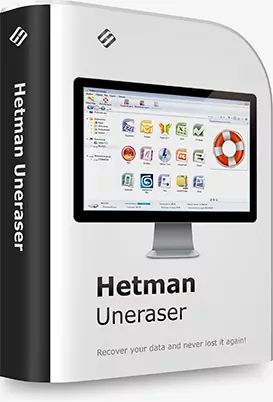
Hetman Uneraser™ 7.5
Uneraser™ recovers files and folders deleted accidentally or permanently from hard drives, SSDs, USB drives, memory cards, and other storage. This includes deletion with Shift + Delete, Option + Command + Delete, supported Linux file-manager shortcuts, emptying the Recycle Bin or Trash, and removal with command-line tools such as DEL, Remove-Item, rm, or unlink.
The software can also access complex storage structures contained on a single physical disk — from disks removed from single-drive NAS devices to server disks exposed through a RAID controller and layered with LVM, thin or thick pools, snapshots, and supported file systems.
You can test Uneraser™ for free: scan the storage, find the files you need, and verify that they can be recovered by previewing their contents before purchasing a license.
Watch this quick-start video for an overview of the key features and see how Uneraser™ recovers deleted files step by step. Use the built-in preview to verify the files you need before recovery — if a file is displayed correctly, it can be fully restored.
Recover files after accidental or permanent deletion, removal by applications, antivirus software, or malware, and access data on disks whose file systems or storage structures are not natively supported by the operating system.

Restore files and folders deleted accidentally, removed with Shift + Delete, Option + Command + Delete, permanent-delete shortcuts in Linux file managers, or erased after emptying the Recycle Bin or Trash. The software also finds files removed with commands such as DEL, Remove-Item, rm, or unlink.

Recover files deleted directly from USB flash drives, memory cards, external HDDs and SSDs, cameras, and other removable storage. On many such devices, deleted files bypass the Recycle Bin or Trash and are removed from the file system immediately.

Find original files removed by applications, cleanup utilities, scripts, or antivirus software. For example, security software may quarantine a suspicious file and delete the original copy from its previous location, while its data may still remain recoverable on the storage device.

Some malware and ransomware create an encrypted, modified, or replacement copy and then delete the original file. Uneraser™ can locate and recover the deleted original when its data and the file-system information required to reconstruct it have not been overwritten.

Access files on disks that the current operating system cannot mount or read natively. Uneraser™ recognizes supported Windows, Linux, and macOS file systems, including NTFS, ReFS, Ext2/3/4, XFS, Btrfs, ZFS, APFS, HFS+, and others, regardless of which supported operating system is used for recovery.

Work with disks removed from single-drive NAS devices, Linux servers, and other systems with nested storage structures. Uneraser™ can recognize supported layers such as controller-created single-disk volumes, LVM, thick and thin pools, snapshots, and file systems, provided the required storage structure is contained on a single physical disk.
Uneraser™ combines fast deleted file recovery with content-aware analysis and practical tools for working with disks and file systems. Browse recovered folders in a familiar interface, preview supported files, inspect storage structures, and verify that the data you need can be recovered before saving it.
Uneraser™ recovers deleted files from HDDs, SSDs, external drives, USB flash drives, SD and microSD cards, other memory cards, and disks removed from computers, NAS devices, or servers. The software can analyze an entire physical disk or a selected partition using file-system metadata and, when required, search for supported file types by their internal content signatures.
HDD, SSD
& SSHD Drives
& SSHD Drives
External
USB disk
USB disk
USB
flash drive
flash drive
SD, microSD
& Other Cards
& Other Cards
- Fast Scan reads the current file-system metadata to locate existing and deleted files and folders. It is the preferred method after accidental deletion, Shift + Delete, emptying the Recycle Bin or Trash, or other permanent file deletion.
- When the file system still retains complete allocation information, Fast Scan can restore the original file name, path, timestamps, and the locations of all file fragments, allowing fragmented files to be reconstructed correctly.
- Content-aware analysis additionally searches for supported file formats by their internal signatures when sufficient file-system records are no longer available.
- Files found only by content signatures may lose their original names, folder paths, timestamps, and other metadata. Because signature-based recovery does not know the original location and order of separate file fragments, fragmented files may be recovered only partially or may be damaged.

Uneraser™ is not limited to specific file types. Fast Scan can recover any file format when the file system still contains the records required to locate its data. This includes documents, photos, videos, audio, archives, databases, backups, source code, configuration files, disk and virtual disk image files, and other user data.
Content-aware analysis provides an additional recovery method for supported formats by identifying files from their internal content signatures. Files found only by signatures may lose their original names, paths, timestamps, and other metadata, and fragmented files may be recovered only partially.
*.docx
*.rtf
*.pdf
*.jpeg
*.psd
*.png
*.xls
*.zip
*.avi
more...

For large or potentially fragmented files such as movies and other large videos, databases, virtual disks, disk images, large archives, and backups, we recommend Partition Recovery™. Its Full Analysis can search for additional file-system structures and metadata that may be required to reconstruct file fragments when the information available to Fast Scan is incomplete.
Uneraser™ runs on Windows, Linux, and macOS and analyzes supported file systems directly, without relying on the operating system to mount or understand them natively. This allows you to access and recover deleted files from disks created on another operating system or platform.
Windows File Systems
FAT, exFAT, NTFS, and ReFS used by Windows desktops, workstations, servers, external drives, and removable storage.
Linux & Unix File Systems
Ext2, Ext3, Ext4, XFS, Btrfs, ReiserFS, ZFS, and UFS used by Linux, Unix/BSD, NAS, and server systems.
macOS File Systems
APFS and HFS+ used by current and previous generations of macOS storage.
The operating system used for recovery does not have to match the operating system that created the storage. For example, you can analyze a supported Linux file system from Windows or macOS, or access supported Windows and macOS file systems from Linux.
Uneraser™ can access deleted files on disks removed from single-drive NAS devices, servers, workstations, and other systems with nested storage structures. The software recognizes supported storage layers directly and follows them through to the file system, even when the host operating system cannot mount the original disk layout natively.
Logical Volumes, Pools & Snapshots
The software supports LVM volumes, thick and thin pools, LVM snapshots, Btrfs snapshots, and supported file-system snapshots, allowing deleted files to be recovered from logical volumes and previous storage states located on a single physical disk.
Nested Server Storage
Uneraser™ can follow several storage layers on one disk — for example, a single-disk volume created by a RAID controller → LVM → thin pool → logical volume → file system — and provide access to the files stored inside.
If a RAID array, LVM volume, Btrfs or ZFS storage pool, or another storage structure spans multiple physical disks, use RAID Recovery™ to reconstruct the storage and access its file systems.
Uneraser™ displays scan results in a familiar Explorer-like interface, where you can browse folders, locate deleted files, view thumbnails, and check recoverable content before saving it. The browsing and preview tools are based on the same interface used in Partition Recovery™.
Browse & Preview Recovered Files
Preview supported documents, photos, videos, audio files, archives, and other content directly in the recovery results. Deleted files remain visible alongside existing data, while thumbnails and folder navigation help you quickly locate the files you need.
Full-Screen Preview & File Details
Open supported files in a full-screen preview and review available details such as the original name, path, size, type, creation and modification dates, and other metadata preserved by the file system.

The preview is available in the free evaluation version, allowing you to find the files you need and verify their contents before purchasing a license. If a file is displayed correctly in the preview, it can be fully restored.
Uneraser™ includes the same advanced disk and file system inspection tools as Partition Recovery™. You can examine physical disks, partitions, logical storage structures, file systems, and individual files, check drive health, and save analysis results to continue recovery later.
Disk Inspection, HEX Editor & Saved Analysis
- Disk, file system, and HEX analysis provides detailed information about physical disks and partitions, available S.M.A.R.T. health and operating data, and low-level inspection of disks, volumes, and individual files. The structure-aware HEX Editor supports search and direct navigation through recognized structures such as partition tables, LVM metadata, boot sectors and backup copies, MFT records and fragments, superblocks, and other file-system metadata.
- Save analysis results and resume recovery later without scanning the storage again. Load previously saved analysis information to continue browsing results, previewing files, selecting the required data, and completing recovery.
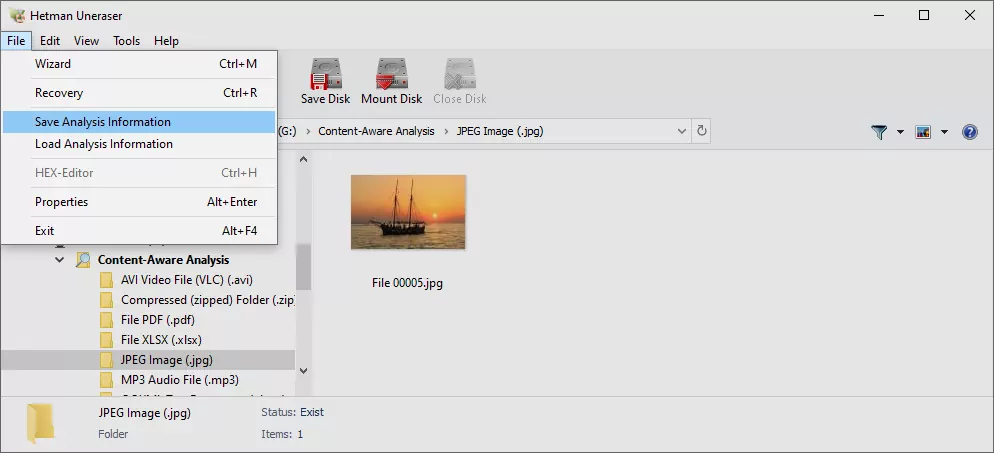
Uneraser™ analyzes storage in read-only mode and does not modify the source disk or overwrite deleted data. After selecting the files you need, the recovery wizard lets you save them to a safe location using several available methods.
Read-Only Analysis
The source storage remains unchanged during scanning, browsing, and preview. To avoid overwriting recoverable data, do not install the software or save new files to the device being recovered.
Recover from Disk Images
Instead of analyzing the original device directly, Uneraser™ can mount and recover files from RAW disk images and DriveImage XML images. Working with an image helps preserve the current state of the source storage during recovery.
Save Recovered Files
Save recovered files to another disk or storage device, combine them into a ZIP archive, or upload them to a remote server via FTP. When available, the original folder structure and file metadata can be preserved.
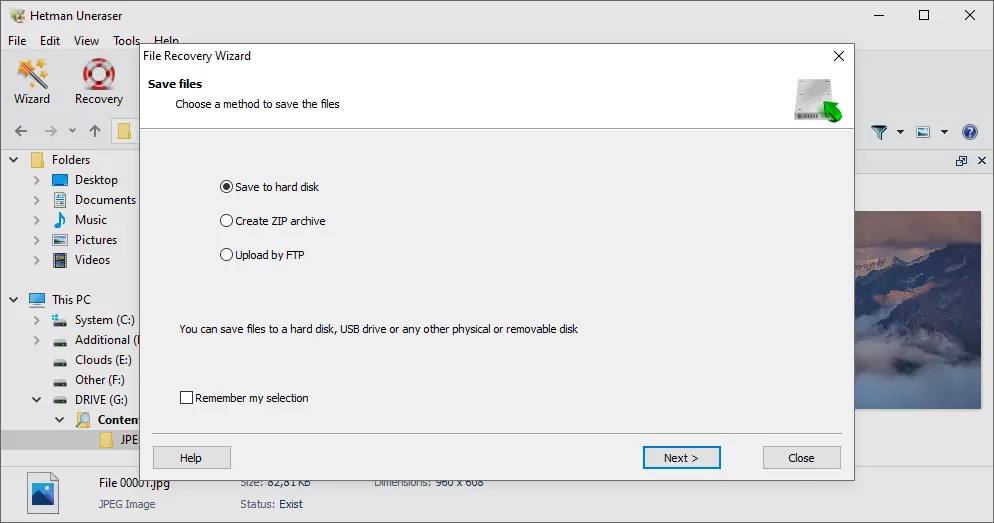
Always save recovered files to a different physical storage device whenever possible. Writing recovered data back to the source disk may overwrite other deleted files that have not yet been restored. For forensic images, Apple disk images, and virtual machine disks, use Partition Recovery™, which supports advanced image formats such as E01/AFF, DMG, VMDK, VDI, VHD/VHDX, QCOW/QCOW2, and others.
-
What is the difference between Hetman Uneraser and Hetman Partition Recovery?
Hetman Uneraser™ is intended primarily for recovering deleted files from an existing and readable file system. It uses Fast Scan and optional content-aware analysis.
Use Hetman Partition Recovery™ when the storage has been formatted, repartitioned, or damaged, is RAW or inaccessible, or is encrypted. Partition Recovery adds Full Analysis to search sector by sector for lost file-system structures and previous metadata states, and supports recovery from virtual machine disks, Apple disk images, and forensic disk images that Uneraser cannot mount or analyze directly.
-
Can Hetman Uneraser recover deleted files from an SSD?
Yes, but successful recovery from an SSD depends strongly on TRIM and garbage collection. If the SSD has already erased the blocks that contained the deleted file, software recovery is no longer possible. For this reason, stop using the affected SSD as soon as possible and scan it before additional data is written.
-
How long after deletion can a file still be recovered?
There is no fixed time limit. A file deleted minutes, days, or even months ago may still be recoverable if its data has not been overwritten.
At the same time, a recently deleted file can become unrecoverable quickly if the storage continues to be actively used. On SSDs, TRIM and garbage collection can shorten this window significantly.
-
Do I need to reinstall Hetman Uneraser or scan the storage again after purchasing or upgrading a license?
No. You can activate the copy of Hetman Uneraser™ that is already installed by entering the registration information from your purchase. There is no need to download or reinstall the software after purchasing or upgrading a license.
You can also continue working with the existing scan results without analyzing the storage again. After activation, return to the previously found files and proceed with recovery.